
Were It Not for Shadows …:
Zeitz Museum of Contemporary Art Africa, Cape Town, 12 November 2026 to 29 August 2027
Cape Town’s Zeitz Museum of Contemporary Art Africa opened a new group exhibition on 12 November 2026 that looks at the part of art-making most visitors never see. Were It Not for Shadows … brings together six Cape Town-based artists who each completed a residency at the museum through the Koyo Kouoh Atelier between 2019 and 2025. It stays on Level 3 until 29 August 2027.
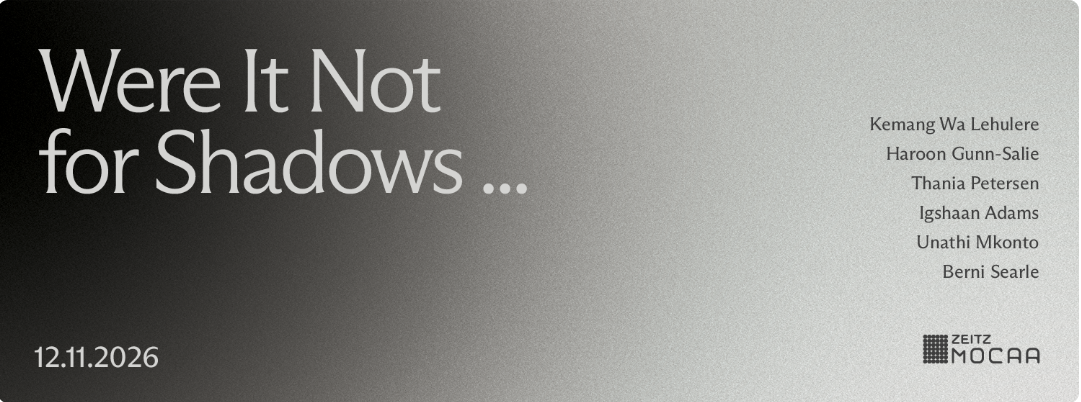
Were It Not for Shadows … exhibition at Zeitz MOCAA, Cape Town. Credit: Courtesy of Zeitz Museum of Contemporary Art Africa.
The six artists are Kemang Wa Lehulere, Haroon Gunn-Salie, Thania Petersen, Igshaan Adams, Unathi Mkonto and Berni Searle. Each is represented by the project that grew out of their time in the Atelier: Laying Bare (2019), Line in the Sand (2020), KASSARAM (2021), Not Working; (Working Title) (2022), TO LET (2023) and On Site (2024). Together they make up a mix of installations, tapestries, sculptures and photographic series that were prompted by, developed during, or emerged from those residencies.
The show is curated by Dr Phokeng Setai, the museum’s Assistant Curator, with help from fellows of the Zeitz MOCAA and University of the Western Cape Fellowship Programme, Bulelwa Kunene and Reem Aljeally.
The title comes from Jun’ichō Tanizaki’s 1933 essay In Praise of Shadows, a meditation on Japanese aesthetics that finds beauty in subtlety and ambiguity rather than harsh light. Tanizaki writes, “Were it not for shadows, there would be no beauty.” The exhibition borrows that idea to talk about time and change, and about the quiet, unseen work that happens in the studio long before a piece is shown.
Setai describes the exhibition as a tribute to artistic process: the sustained experimentation, the early ideas and the countless hours that go on away from public view. In that sense, “shadows” here are not a lack of attention but the place where work takes shape.
A second reference point is the Crystallist Manifesto, written by members of the Crystallist School in Khartoum, Sudan. It treats art as a crystal, with many facets that reflect and refract light, and argues that no single point of view can contain the whole truth. That openness shapes how visitors are invited to read the works, which are offered as orientations rather than fixed conclusions.
Some of the works respond directly to the museum itself, through site-specific commissions and interventions in its architecture. Others engage embodied histories, the aftermath of political events and the spiritual practices that sit within South Africa’s multicultural landscape.
For readers following African art, the show is a reminder of how much happens inside institutions before an exhibition opens, and a chance to see six distinct Cape Town practices placed in conversation. It forms part of Zeitz MOCAA’s series of research-driven exhibitions that centre artists from Africa and its diaspora, supported by the Mellon Foundation and BMW South Africa.
Visit: Zeitz MOCAA, Silo District, V&A Waterfront, Cape Town. 12 November 2026 to 29 August 2027, Level 3. The museum is open daily from 10am to 6pm, with last entry at 5:30pm. Check its website for current hours and tickets.
Sources and image links
- Museum announcement (main source, published on e-flux): https://www.e-flux.com/announcements/6788132/were-it-not-for-shadows
- Zeitz MOCAA website (exhibition information, tickets and press team): https://zeitzmocaa.museum/