
Merikokeb Berhanu in Seoul: Looking Back at Cellular Memory
Esther Schipper, Seoul, 9 June to 14 August 2026
This summer, the Ethiopian painter Merikokeb Berhanu showed her work in Asia for the first time. Cellular Memory ran at Esther Schipper in Seoul from 9 June to 14 August 2026. It was her second solo exhibition with the gallery and centred on a small group of new paintings, six according to the gallery’s press release. The show has closed, but it captures an artist at a turning point.
Merikokeb was born in Addis Ababa in 1977. She graduated from Addis Ababa University’s Alle School of Fine Arts and Design in 2002, with a focus on mural design, and studied painting under Getahun Assefa. His generation of Ethiopian artists built on the work of modernist pioneers such as Skunder Boghossian, pushing towards greater abstraction and a closer look at social realities. She moved to the United States in 2017 and lives and works there. Her visual language blends the history of Ethiopian art, its absorption of modernist influences, and the experience of diaspora.
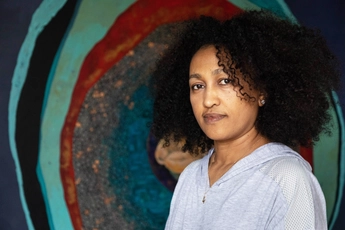
Merikokeb Berhanu Credit: estherschipper.com
The paintings in Seoul were made in 2026 specifically for the exhibition and work across a range of scales, from the large Untitled CXIV to smaller, more concentrated compositions such as Untitled CXX. They continue the semi-abstracted figurative language she has developed over the past decade, while moving into new colour and composition. Interlocking organic forms suggest bodies, landscapes and cellular structures all at once, without settling on any one. A foot or a hand appears, but stands for a general human presence. Elongated shapes with rounded heads could be a bunch of flowers or a community of people.
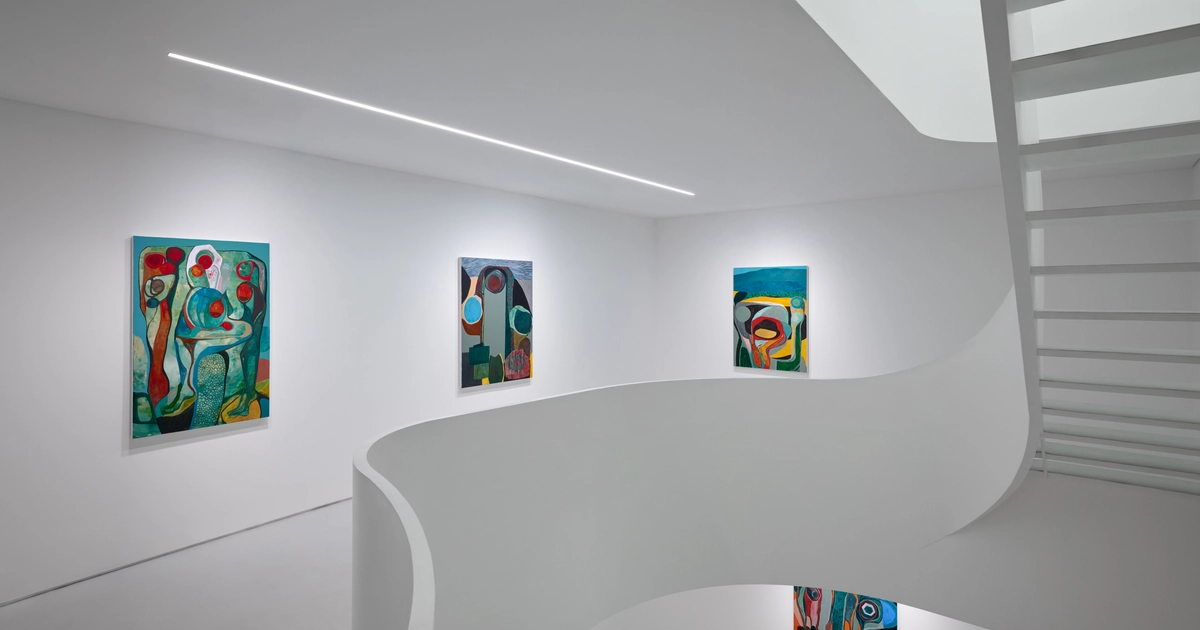
Credit: Exhibition view: Merikokeb Berhanu, Cellular Memory, Esther Schipper, Seoul, 2026. Photo © Haengjin Lee.
The thread running through the group is the tension between the natural and the technological. The gallery links this to her move to the United States, where she confronted mass consumption, pollution and climate change. In Untitled CXX, budding red forms on one side find a mirror in what look like crimson circuit-board orbs on the other, with root-like structures below anchoring both in the same soil. Untitled CXVIII works like a geological cross-section, with layers of living matter and circuit-board tracery beneath the surface, like a “second nervous system” growing through the earth. In these paintings, nature and technology feel less like opponents and more like two systems finding a way to coexist.
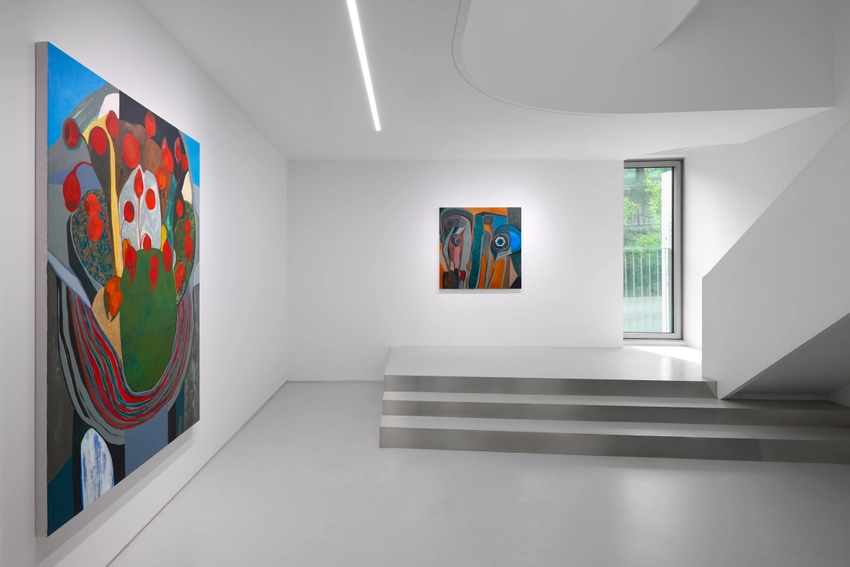
Exhibition view: Merikokeb Berhanu, Cellular Memory, Esther Schipper, Seoul, 2026. Photo © Haengjin Lee.
Her career has moved quickly. She was included in the 2022 Venice Biennale, The Milk of Dreams, and in Making Their Mark, a show from the Shah Garg Collection curated by Cecilia Alemani. She appeared in Ethiopia at the Crossroads at the Peabody Essex Museum and had solo shows at Esther Schipper in Berlin and James Cohan in New York in 2025. Her work is in the collections of Tate, the San Francisco Museum of Modern Art, the Denver Art Museum and the Baltimore Museum of Art, among others. In 2025 she became co-represented by James Cohan, Addis Fine Art and Esther Schipper.
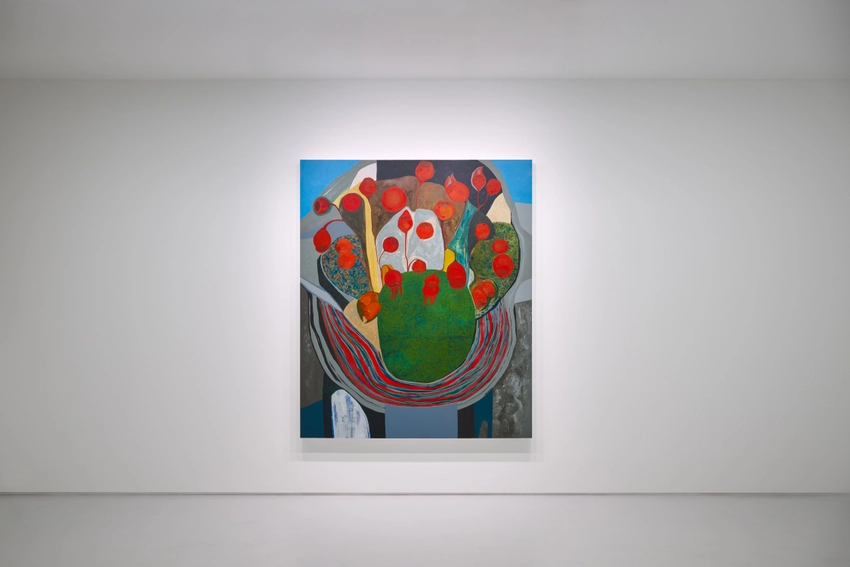
Exhibition view: Merikokeb Berhanu, Cellular Memory, Esther Schipper, Seoul, 2026. Photo © Haengjin Lee.
For readers following African art, Merikokeb’s paintings show how Ethiopian modernism and diasporic experience can meet in a language of her own, one that rewards slow looking.
Where to find her work now: the Seoul exhibition has closed. Check Esther Schipper’s website and Addis Fine Art for upcoming presentations.
Sources and image links
- Gallery exhibition page (main source, with the exhibition views): https://www.estherschipper.com/exhibitions/1565-cellular-memory-merikokeb-berhanu/
- Gallery press release (full text): https://dailyartfair.com/events/download_press_release/21357